
We’re Singaporeans. We all love food. It is such a basic, physical part of our lives, and for Christians, the dining table is a place of fellowship and hospitality. But we must pay attention to what and how we eat, for it has spiritual and physical implications for us. As Richard Hartung highlighted in his article , the Bible teaches us how to eat rightly as God’s people. In 1 Corinthians 10, Paul writes, “whether you eat or drink or whatever you do, do it all for the glory of God.” This points us towards better stewardship of our health, finances and creation through our eating practices.
But while health and finances are fairly clear as individual matters, understanding our individual food choices as creation care in action may be more abstract. This is perhaps because as consumers in Global North cities, we are often greatly distanced from the workings of the modern food system. All the more so in Singapore, where we import more than 90% of our food. 1 Yet it is a system that has very real effects of ecological destruction and greenhouse gas emission, which have very real implications on the food security and livelihoods of people near and far away from us.
If we believe that caring for God’s creation is part of living out His commandments to love Him and love our neighbours, it is then worth learning about the realities and complexities of the food system’s impacts on creation. It will show us what considerations to make as we seek to honour God in our eating – a daily act that should also be done for the glory of God. It is certainly not for the sake of following worldly social trends in food, and not purely for health and financial reasons – though they are also biblically valid considerations. Good choices steward our God-given bodies and wealth, but they can also be borne out of a conscious, biblical approach to our participation in the global food system.
The geographies of food
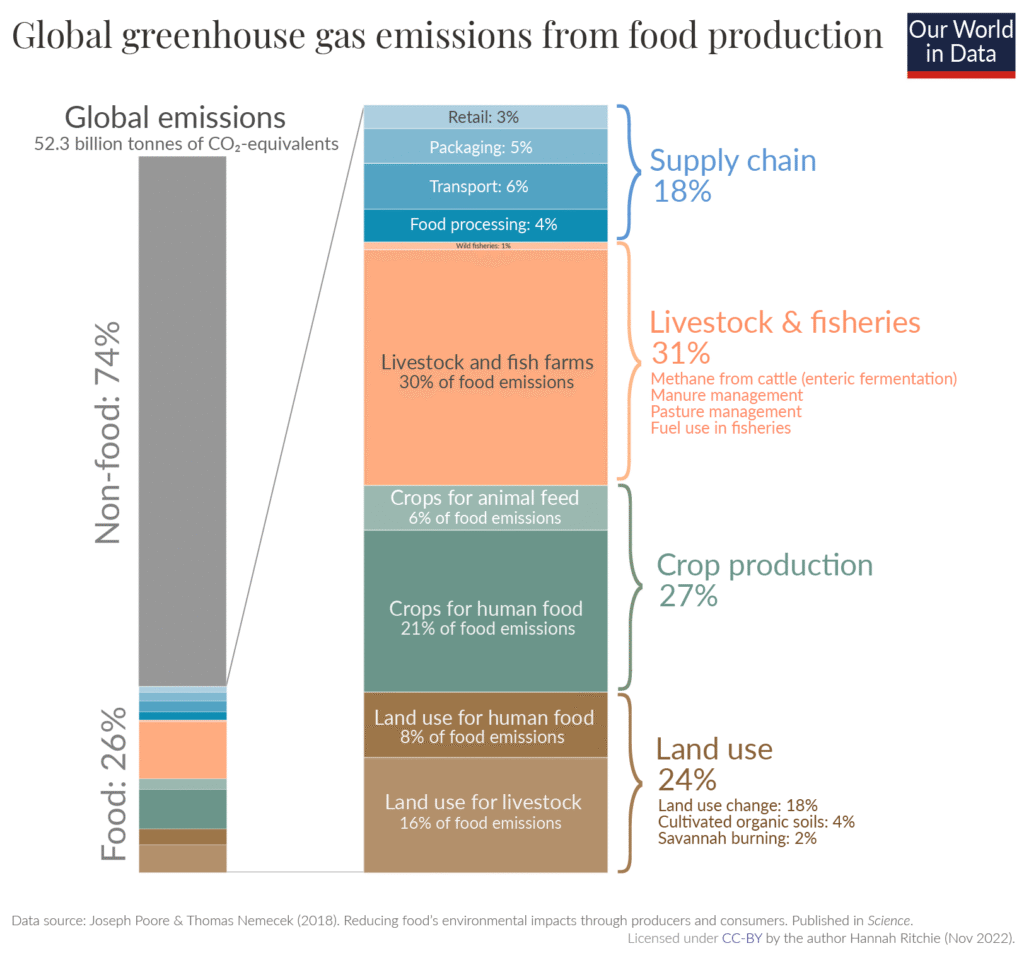
The food system contributed 30% of greenhouse gas emissions in 2022.5 Emissions will also increase as the agricultural sector adapts to cope with climate change, creating a feedback loop.6 Global food systems are the largest contributor to the transgression of five of our nine planetary boundaries,7 including “80% of deforestation, 70% of freshwater use, and (being) the single greatest cause of terrestrial biodiversity loss.”8
Livestock production produces around half of the food system’s emissions,9 meaning our meat consumption is responsible for around 15% of all emissions globally. Its outsized environmental impacts also extend to zoonotic disease risk, antibiotic resistance,10 water and soil pollution,11 and deforestation.12 Feed production for livestock also contributes towards this: for example, 75% of soy is used for animal feed rather than direct human consumption.13
In the water, one-third of assessed global fish stocks are being overfished.14 Millions of other marine animals are also affected by fishing bycatch, caught and discarded by large-scale fishing operations.15 In addition, aquatic ecosystems are affected by pollution from agricultural runoff.16
These issues affect humans just as much as the rest of creation, but there is a disproportionately greater impact on vulnerable and marginalised communities.17 This problem remains the same at regional, national, and global scales: places with higher income and development have greater capacity to cope with climate change, and hardly feel the effects of environmental destruction. This is because agricultural production, among other problematic activities, tend to be physically distanced away. In addition to climate change impacts, poorer residents of those areas also suffer directly from deforestation, biodiversity loss, pollution, water scarcity and more. Coastal communities will also keenly feel the loss of disruptions in aquatic ecosystems.
Being a system, the negative externalities of food production also come around to affect our food practices. The impact is deep when foods are deeply embedded in culture (e.g. kimchi in South Korea is being threatened as warmer weather makes growing napa cabbage difficult),18 and even more so when the very livelihoods of those who depend on subsistence farming are threatened.
Food and Singapore
What is Singapore’s place in all this? A 2019 study by A* STAR and Deloitte and the Singapore Food Agency’s annual Singapore Food Statistics publication are illuminating for our understanding of our food system.
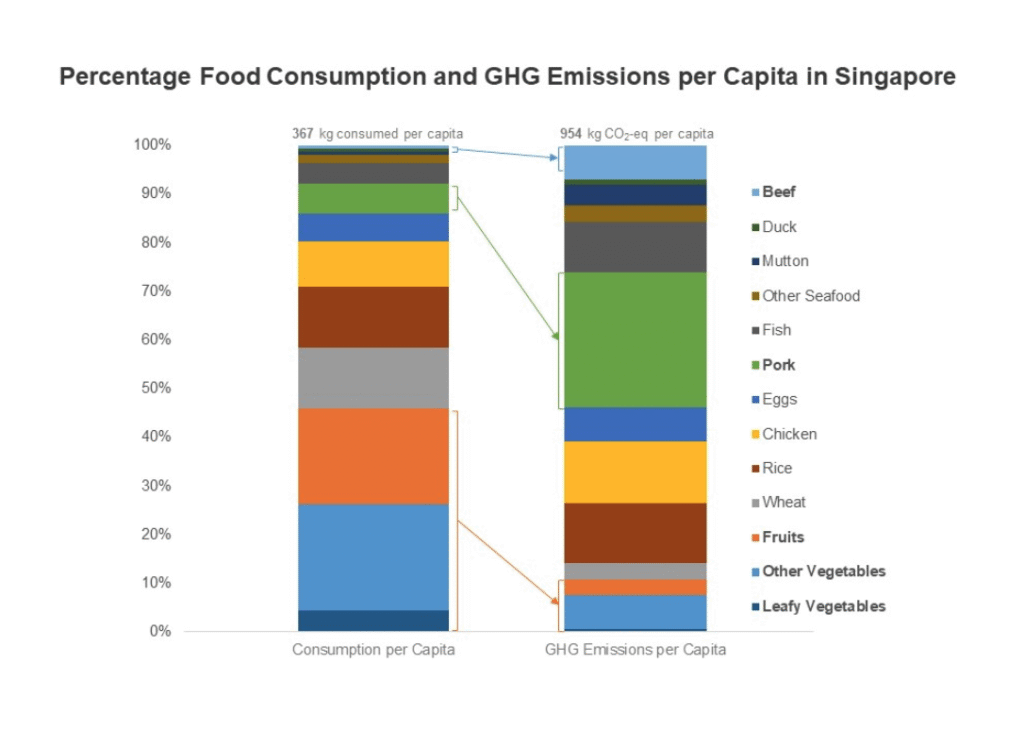
L: Food consumption per capita. R: Greenhouse gas emissions per capita. Both columns split by food type. Source: Ecosperity19
Meat, specifically pork, mutton and beef, have environmental impacts disproportionate to their portion of our diets. Although red meats are about 11% of consumption by weight, they contribute 40% of our food’s greenhouse gas emissions. Notably, pork contributes 28% of all emissions while only accounting for 6% of food consumed by weight.
Our desire for freshness also greatly impacts emissions:
Chilled air-flown pork, mutton, beef and fish account for only about 9% of food consumed but they contribute to about 65% of the energy used for transporting all food items to Singapore.
What do we make of all this?
It may feel overwhelming to consider all the harms associated with the simple act of eating foods that we enjoy – and they’re not necessarily our fault given the industrialised, globalised market way our modern food system operates. Our role in this is still present, nevertheless. Our first response can be to wrestle with God about these issues – ask Him to point out our individual culpability, to convict us of the need for repentance, and for His grace to cover us when we do so.
These issues feel far, far bigger than what is reasonably within our capacity to take action on. If the Spirit has convicted you, and the brokenness of this situation brings you sorrow, the next helpful action will be to lament. Not only is there an entire book in the Bible housing poetic laments, nearly a third of the Psalms are also about lament. Jesus lamented, too (Luke 13:34-35). We bring our feelings to God in a way that helps us look to Him, and gradually learn how to trust in His sovereignty and goodness over all situations.
What follows is hope drawn from Christ’s resurrection, even in the midst of uncertainty and desolation, facing down global political and economic forces. Nothing in this world can undo the victory of Christ (Romans 8:38-39) and His renewing work of all creation (Romans 8:19-23).
These can empower us to continue acting on our convictions, rooted in a love of God and love of our neighbour. Bethany Sollereder suggests the serenity prayer as a model for living this out everyday:
God, grant me the serenity
to accept the things I cannot change
the courage to change the things I can
and the wisdom to know the difference.
As we seek to live better – to do justice, love mercy, and walk humbly with our God (Micah 6:8), we can do so keeping in mind His promises of things to come.
So how can we makan better?
An easy, yet difficult, action is to begin reducing our meat intake. Becoming comfortable with taking meat out of just a few meals a week can forward a global shift towards flexitarian diets that can meaningfully reduce global emissions.27 It also directly lessens pressure on the places and people whose livestock industries we source from.
We can also change our seafood practices to be more sustainable. Beyond clear actions like avoiding shark and ray dishes, all fish choices can be more carefully made. Look out for seafood labels like the Marine Stewardship Council (MSC), Aquaculture Stewardship Council (ASC), and Best Aquaculture Practices (BAP). Follow the WWF’s guide, or this more recent resource from local organisation Pasarfish.
Finally, continue to learn more about our food. Find out where it comes from. Who are the companies involved in making it? What are its local, regional, and global impacts on creation, human and non-human? Education helps to shine light on the brokenness of systems and the plight of people around us. More importantly, it shows us how/where we can work to bring God’s love in intervening. It reveals who to pray for, what awareness needs to be raised, what efforts can be supported with your time, talents, and treasures. Individual choices are important acts of discipleship, but be open to how God is challenging you to work on a bigger, systemic scale to renew creation and reach out to the least of us.
Sollereder’s practical advice is to split effort between personal lifestyle changes and pursuing systemic change, through advocacy, education, and political participation. “I have a greater chance of making a large-scale difference than if I put all my efforts into making my private life perfect,” she writes.
While changing one’s diet may be difficult, it may be helpful to look at broader biblical approaches to food, which show how it relates to us and God. On top of being practically helpful, you may find them edifying for the daily practice of your faith.
The Creator provides food for us: He made every tree that is “good for food” (Genesis 2:9) and gave plants and animals to us for food (Genesis 9:3). He sustained the Israelites in the desert with manna (Exodus 16), and does the same for us with all food today. Jesus endorsed feasting – showing not only the biological imperative of food but the goodness of, well, good food. When we eat and drink, then, we should do so in gratitude for His provision, and delight in His goodness.
Relating God to our eating is naturally accompanied by doing the same for not eating. Separate from warnings against gluttony and over-indulgence in food (Proverbs 23:20-21, Philippians 3:19) are numerous calls to, and examples of, fasting. Jesus commends fasting, and we continue doing so today to draw us closer to God. It reminds us that He is our ultimate physical sustainer; the one whom we draw breath from and who allows our bodies to continue doing so – no matter what we eat, or whether we even eat at all.
I think we should say with our bodies periodically (and there is no New Testament rule here that tells you how often to fast), “I love you, God. I love you more than I love food. I need you more than I need food. I want you more than I want food. You taste better to me spiritually than food tastes to me physically.” - John Piper 28
We can therefore use principles from both feasting and fasting when we look in disappointment at a plate that is mostly green, or struggle to pass over tender char siew and fragrant chicken rice stalls. We can learn to delight in God’s provision of ingredients that He created, view our food with thankfulness, and seek to make His sustenance of our spirits and bodies more important than the satisfaction of our taste buds.
Some final words
It is important to be careful of over-righteousness as we act out convictions about our food.
One person believes he may eat anything, while the weak person eats only vegetables. Let not the one who eats despise the one who abstains, and let not the one who abstains pass judgment on the one who eats, for God has welcomed him. Who are you to pass judgment on the servant of another? It is before his own master that he stands or falls. And he will be upheld, for the Lord is able to make him stand. - Romans 14:2-4
It is easy to fall into the trap of preaching and judgement, making our moral convictions more important than fellowship and love that points us all to Christ. He has saved the world, not our diets.
At the same time, in light of all that has been written here, do consider eating more sustainably as a continual act of discipleship, a posture of worship.
Recommended Reading
If you are interested in exploring the Bible’s wisdom on food and how we can relate it to our food system today, here are some works that have been helpful for writing this essay:
- Batzig, Nicholas. “A Biblical Theology of Food and Drink.” Feeding On Christ, February 15, 2012. https://www.feedingonchrist.com/blog/post/a-biblical-theology-of-food-and-drink.
- Camera, David. “Eating Together.” Tabletalk, January 1, 2018. https://tabletalkmagazine.com/article/2018/01/eating-together/.
- Grabowski, Philip P. “Eat Lovingly: Christian Ethics for Sustainable and Just Food Systems.” Christian Scholar’s Review, August 26, 2024. https://christianscholars.com/eat-lovingly-christian-ethics-for-sustainable-and-just-food-systems/.
- Mathis, David. “Fasting, Feasting, and Our Daily Bread.” Desiring God, August 2, 2023. https://www.desiringgod.org/articles/fasting-feasting-and-our-daily-bread.
- Perry, Bob. “Thought for Food.” Christian Research Institute, July 23, 2017. https://www.equip.org/articles/thought-for-food/.
References
1. Singapore Food Agency. “Singapore Food Statistics 2024.” Singapore Food Agency, June 5, 2025. https://www.sfa.gov.sg/news-publications/newsroom/singapore-food-statistics-2024.
2. Kneafsey, Moya, Damian Maye, Lewis Holloway, and Michael K. Goodman. Geographies of Food: An Introduction. Bloomsbury Academic, 2021.
3. Grabowski, Philip P. “Eat Lovingly: Christian Ethics for Sustainable and Just Food Systems.” Christian Scholar’s Review, August 26, 2024. https://christianscholars.com/eat-lovingly-christian-ethics-for-sustainable-and-just-food-systems/.
4. Yang, Yi, David Tilman, Zhenong Jin, et al. “Climate Change Exacerbates the Environmental Impacts of Agriculture.” Science 385, no. 6713 (2024): eadn3747. https://doi.org/10.1126/science.adn3747.
5. Ritchie, Hannah. “Food Production Is Responsible for One-Quarter of the World’s Greenhouse Gas Emissions.” Our World in Data, November 6, 2019. https://ourworldindata.org/food-ghg-emissions.
6. “Greenhouse Gas Emissions from Agrifood Systems. Global, Regional and Country Trends, 2000–2022.” Food and Agricultural Organization of the United Nations, November 14, 2024. https://www.fao.org/statistics/highlights-archive/highlights-detail/greenhouse-gas-emissions-from-agrifood-systems.-global–regional-and-country-trends–2000-2022/.
7. “New Landmark EAT-Lancet Commission Warns Food Systems Breach Planetary Limits.” EAT, October 2, 2025. https://eatforum.org/update/eat-lancet-commission-warns-food-systems-breach-planetary-limits/.
8. The Global Land Outlook, Second Edition. United Nations Convention to Combat Desertification, 2022. https://www.unccd.int/sites/default/files/2022-04/UNCCD_GLO2_low-res_2.pdf.
9. Blaustein-Rejto, Dan, and Chris Gambino. “Livestock Don’t Contribute 14.5% of Global Greenhouse Gas Emissions.” The Breakthrough Institute, March 20, 2023. https://thebreakthrough.org/issues/food-agriculture-environment/livestock-dont-contribute-14-5-of-global-greenhouse-gas-emissions.
10. Herzon, Irina, Rachel Mazac, Maijaliisa Erkkola, et al. “Both Downsizing and Improvements to Livestock Systems Are Needed to Stay within Planetary Boundaries.” Nature Food 5, no. 8 (2024): 642–45. https://doi.org/10.1038/s43016-024-01030-w.
11. Poore, J., and T. Nemecek. “Reducing Food’s Environmental Impacts through Producers and Consumers.” Science 360, no. 6392 (2018): 987–92. https://doi.org/10.1126/science.aaq0216.
12. Ritchie, Hannah. “Drivers of Deforestation.” Our World in Data, February 4, 2021. https://ourworldindata.org/drivers-of-deforestation.
13. Fraanje, Walter, Tara Garnett, and Helen Breewood. Soy: Food, Feed, and Land Use Change. Food Climate Research Network, 2020. https://doi.org/10.56661/47e58c32.
14. Ritchie, Hannah. “Drivers of Deforestation.” Our World in Data, February 4, 2021. https://ourworldindata.org/drivers-of-deforestation.
15. “Bycatch.” World Wildlife Foundation. https://www.worldwildlife.org/our-work/oceans/sustainable-seafood/wild-caught-seafood/bycatch/.
16. Xia, Yinfeng, Ming Zhang, Daniel C. W. Tsang, et al. “Recent Advances in Control Technologies for Non-Point Source Pollution with Nitrogen and Phosphorous from Agricultural Runoff: Current Practices and Future Prospects.” Applied Biological Chemistry 63, no. 1 (2020): 8. https://doi.org/10.1186/s13765-020-0493-6.
17. King, Andrew D., and Luke J. Harrington. “The Inequality of Climate Change From 1.5 to 2°C of Global Warming.” Geophysical Research Letters 45, no. 10 (2018): 5030–33. https://doi.org/10.1029/2018GL078430.
18. Choi, Sebin, and Young Yi Hyun. “Kimchi No More? Climate Change Puts South Korea’s Beloved Cabbage Dish at Risk.” Reuters, September 3, 2024. Kimchi no more? Climate change puts South Korea’s beloved cabbage dish at risk. https://www.reuters.com/world/asia-pacific/kimchi-no-more-climate-change-puts-south-koreas-beloved-cabbage-dish-risk-2024-09-03/
19. Ecosperity. “What Is the Environmental Impact of Food in Singapore?” Temasek, October 30, 2019. https://www.ecosperity.sg/content/temasek-ecosperity/en/insights/articles/environmental-impact-of-food-in-singapore.html.
20. Fraanje, Walter, Tara Garnett, and Helen Breewood. Soy: Food, Feed, and Land Use Change. Food Climate Research Network, 2020. https://doi.org/10.56661/47e58c32.
21. Savian, Michelle, Carla da Penha Simon, and Nicholas M. Holden. “Evaluating Environmental, Economic, and Social Aspects of an Intensive Pig Production Farm in the South of Brazil: A Case Study.” The International Journal of Life Cycle Assessment 28, no. 11 (2023): 1544–60. https://doi.org/10.1007/s11367-023-02223-4.
22. OECD/FAO. OECD-FAO Agricultural Outlook 2025-2034. OECD Publishing, 2025. https://doi.org/10.1787/601276cd-en.
23. 75% of Popular Seafood in Singapore Not Responsibly Caught. WWF Singapore, October 4, 2016. https://www.wwf.sg/75-of-popular-seafood-in-singapore-not-responsibly-caught/.
24. Clark-Shen, Naomi, Kathy Xu Tingting, Madhu Rao, et al. “The Sharks and Rays at Singapore’s Fishery Ports.” Fisheries Research 235 (March 2021): 105805. https://doi.org/10.1016/j.fishres.2020.105805.
25. Clark-Shen, N., A. Chin, C. Gan, et al. “Overfished and under Conserved: Life-History, Ecology and Supply Chain of the Endangered Whitespotted Whipray (Maculabatis Gerrardi) and Sharpnose Whipray (Maculabatis Macrura) from South-East Asia.” Pacific Conservation Biology 31, no. 2 (2025): PC24086. https://doi.org/10.1071/PC24086.
26. “Shared Waters, Shared Futures: ASEAN-Led Cooperative Fisheries Governance In The South China Sea.” The Yale Review of International Studies, January 27, 2025. https://yris.yira.org/column/shared-waters-shared-futures-asean-led-cooperative-fisheries-governance-in-the-south-china-sea/.
27. Humpenöder, Florian, Alexander Popp, Leon Merfort, et al. “Food Matters: Dietary Shifts Increase the Feasibility of 1.5°C Pathways in Line with the Paris Agreement.” Science Advances 10, no. 13 (2024): eadj3832. https://doi.org/10.1126/sciadv.adj3832.
28. Piper, John. “A Bite-Sized Theology of Food.” April 16, 2014. https://www.desiringgod.org/interviews/a-bite-sized-theology-of-food.